
India on Monday signed a civil nuclear cooperation deal with South Korea, allowing a framework for Korean companies to participate in atomic power plant projects in the country.

The agreement will form the basis of wide-ranging bilateral cooperation from basic and applied research to full civil nuclear cooperation, including reactors, nuclear fuel supply, nuclear safety, radiation and environment protection and nuclear fuel cycle management, officials said. The nuclear agreement and the social security pacts were signed after the Summit meeting between Prime Minister Manmohan Singh and French President Nicholas Sarkozy at the Elysee Palace in Paris.
The Berman Bill H R 7081, named after Howard Berman, a Democrat strongly opposed to the deal on non-proliferation grounds and who converted only a couple of days back, was adopted with 86 voting for and 13 against. The Senate also rejected the killer amendments introduced by Democratic Senators Byron Dorgan and Jeff Bingaman to ensure that the US nuclear exports to India do not help boost New Delhi's nuclear weapons programme

'For the first time in a hundred years, the army has been taken out of the political equation. And for the first time ever, there is only one man who calls the shots. Not even Mao had this kind of power.'

The enduring relationship between the two countries have survived the disintegration of the erstwhile USSR in 1991, the end of the Cold War and the regime change in both countries, points out Rup Narayan Das.
The proposed India-United States nuclear agreement provides undefined India-specific safeguards and fails to explicitly state whether the US nuclear trade will terminate if India conducts a nuclear test.
Prime Minister Manmohan Singh is hopeful that progress will be made on the India-United States nuclear agreement, despite domestic political opposition. "Our domestic politics has prevented us from going ahead. I will still continue to hope that we will make progress in the months that lie ahead," Dr Singh said in New Delhi on Wednesday."This agreement, if it materialises, if it sees light of the day, will open new possibilities of cooperation," he said.

Over the years, India-EU ties have grown, and covered trade, investment, climate change, science and technology, space, digital, mobility, and connectivity.
India and Russia today signed an agreement on civil nuclear cooperation with Prime Minister Manmohan Singh describing it as a "new milestone" in bilateral relations.
'The Indo-US nuclear agreement is a political deal masquerading as a technology treaty. The essence of the deal is politics, with technology and the energy it is supposed to bring simply a smokescreen. The aim is to redraw the global politico-strategic framework under the guise of providing technology, energy, and power. But like all power that is not earned, produced, there is a cost. And it is this cost that gets the goat of most Indians.'
'If anybody in the US thinks that because we have an agreement or hold joint naval exercises, we will acknowledge their determination of whom we should deal with, then they are mistaken.'
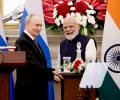
Russia, being bogged down by the Ukraine war and prioritising the requirements of its own armed forces, along with India's consistent diversification policy, will remain a major challenge to the bilateral partnership, note Harsh V Pant and Aleksei Zakharov.
The CPI-M general secretary on why his party opposes the India-US nuclear deal.

'Nor would it have serious implications in India's relations with Saudi Arabia that stand on their own and have improved significantly in recent times, including in defence and strategic affairs.'
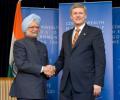
Canadian Prime Minister Stephen Harper and Indian Prime Minister Manmohan Singh on Saturday announced in Port of Spain that they had reached an agreement on the civilian nuclear agreement.
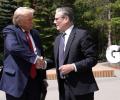
US President Donald Trump has cut short his visit to Canada, where he was to attend G7 Summit meetings, to return to Washington, DC, a day earlier amid escalating tensions between Iran and Israel.
US President Donald Trump has claimed that India and Pakistan "made peace" in May after he threatened to snap trade deals with them if they continued their military conflict.

India has approved proposals to procure weapons and military hardware worth Rs 79,000 crore, including Nag missiles, amphibious warfare ships, and electronic intelligence systems, to enhance the military's combat capabilities.
'Even China and Russia would not challenge the technology apartheid unless India was able to enhance its relationship with the United States.'
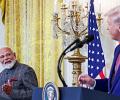
Prime Minister Narendra Modi and US President Donald Trump have vowed to move forward with plans to work together to build US-designed nuclear reactors in India. The decision was made during their meeting at the White House, where they also agreed to significantly expand energy cooperation. The move comes after India announced plans to amend its nuclear liability law and the Atomic Energy Act, which had previously been obstacles to the implementation of the US-India civil nuclear deal.

If Xi Jinping can establish control over the PLA Ground Force, relations between India and China will settle down to an even keel. The next few weeks will show whether Xi has finally succeeded in gaining control over the PLA Ground Force. That could bring about the substantive shift in India-China relations that both our leaders have been working for, observes Ambassador Prabhat Shukla.
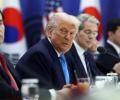
United States President Donald Trump on Wednesday lavished praise on Prime Minister Narendra Modi as the 'nicest-looking guy' while describing him as a 'father' but also calling him 'a killer' and 'tough as hell', while hinting at an imminent trade deal between the two countries.

United States President Donald Trump reiterated the claims of having to do 'something' about Greenland, saying that if US doesn't take any action, Russia and China would spring in and that Washington, DC does not want to have them as neighbours.
Recently, Iran and western powers signed a deal in which it was agreed the West Asian nation would scale down its nuclear programme in exchange for a cut in economic sanctions.
India and Japan are close to finalising a civil nuclear cooperation agreement, former Japanese prime minister Yukio Hatoyama said in New Delhi on Monday."India and Japan have come to a stage of concluding the nuclear cooperation agreement," said Hatoyama, a key leader of the ruling Democratic Party of Japan.He hoped India would uphold its unilateral moratorium on nuclear tests and underscored the sensitivity Japanese people attach to it.

The deal would allow Japan to export nuclear technology to India.

US President Donald Trump claimed to have resolved the conflict between India and Pakistan, stating that 'seven brand new' planes were shot down during the conflict. He reiterated that he used trade as leverage to achieve this resolution.
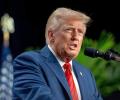
Trump said that leaders in India and Pakistan are "great leaders" and "they understood, and they agreed, and that all stopped".

Defence Minister Rajnath Singh lauded the armed forces' performance during Operation Sindoor, emphasizing the importance of technology and adaptability in modern warfare. He urged air force commanders to learn from the operation and stay prepared for future challenges.
The United States has said that it will vote against an exemption for China to sell two civil nuclear reactors to Pakistan at the Nuclear Suppliers Group meeting, in a new move to step up pressure to get the controversial deal annulled. Making it clear that the US will oppose the recent decision of China to sell two nuclear reactors to Pakistan, a top Barack Obama administration official told lawmakers that Washington will vote against the China-Pakistan deal.
Crossing a significant milestone, the Indo-French civil nuclear agreement was unanimously adopted by the French Parliament, paving the way for companies to build nuclear power plants in India. The French National Assembly on Tuesday adopted a law authorising the ratification of the Cooperation Agreement between India and France on the Development of Peaceful Uses of Nuclear Energy, a French Embassy statement said. The French Senate had adopted the law on October 15.
Four new nuclear reactors of 1,000 MW capacity each will be set up in Kudankulam in Tamil Nadu after India finalises a deal on it with Russia in June this year, a top scientist has said. The four 'VVER-type' reactors will be in addition to two 1,000 MW reactors which are already being constructed there. "India and Russia have already signed other enabling accords like agreements on sharing of information," Nuclear Power Corporation Chairman S K Jain said.
Menon clarified that there were no conditions attached with the deal.

The White House on Thursday stated that United States President Donald Trump is 'extremely frustrated' with both Russia and Ukraine over the slow progress toward ending the ongoing war and is unwilling to engage in 'meetings just for the sake of meeting'.
Pakistan has gained atomic capabilities through "international deception" and "clandestine procurement" networks, eminent US lawmakers have said, while warning that the continuation of 'secretive' Sino-Pak nuclear ties is setting a wrong precedence for others.
India and South Korea have reached an agreement on civil nuclear cooperation.
The French move assumes significance as it comes close on the heels of conclusion of Indo-US civilian nuclear deal.
It's highly unlikely that China will give up playing the Pakistan card vis-a-vis India anytime soon. Indian policy makers would be well advised to disabuse themselves of the notion of a Sino-Indian rapprochement. China doesn't do sentimentality in foreign policy, India should follow suit, writes Harsh V Pant.
During his first official visit to India, Canadian Prime Minister Stephen Harper indicated that he would like the two countries to sign the civilian nuclear agreement and the foreign protection promotion and investment agreement.Disappointed by the lackluster visit, Canadian journalists accompanying Harper are wondering why the two countries haven't signed the nuclear agreement so far, in spite of discussing such an agreement at length since a long time.
